The Star Myths: Pleiades, Orion
The ancient Greeks didn’t just see random stars when they looked at Pleiades and Orion—they saw navigational lifelines. These constellations guided sailors through treacherous Mediterranean waters and helped farmers predict seasonal changes with remarkable accuracy. While modern technology’s replaced celestial navigation, the myths surrounding these star clusters reveal something deeper about human nature. What drove countless civilizations to create strikingly similar stories about the same stellar patterns remains one of astronomy’s most intriguing mysteries.
Introduction
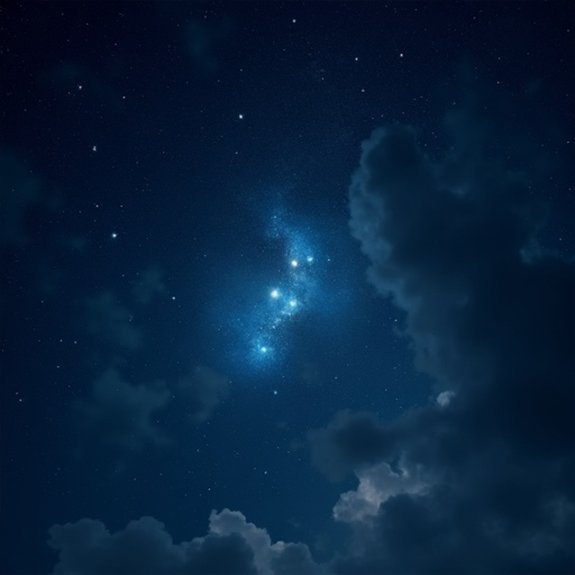
When ancient peoples gazed up at the night sky, they didn’t just see random points of light—they saw stories waiting to be told. The Pleiades star cluster and Orion constellation became central characters in mythologies across civilizations. These celestial formations sparked humanity’s imagination for millennia, inspiring tales that explained natural phenomena, taught moral lessons, and preserved cultural knowledge.
Different cultures interpreted these star patterns through their unique worldviews. Greeks saw seven sisters fleeing a hunter. Japanese observers counted six stars and called them Subaru. Aboriginal Australians recognized the Seven Sisters dreaming story. Meanwhile, Orion’s distinctive belt and bright stars made him a warrior to Babylonians, a drum to Japanese stargazers, and Osiris to ancient Egyptians. These diverse interpretations reveal how humans universally sought meaning in the cosmos.
Ancient Greek Sailors’ Navigation Guide
Greek sailors transformed these mythological star patterns into practical navigation tools that guided them across the Mediterranean’s dark waters. They’d watch Orion rise in the east during autumn evenings, marking the start of winter’s stormy season. His belt’s three distinctive stars pointed toward Sirius, the brightest star in the night sky.
The Pleiades cluster served as their seasonal calendar. When these “sailing stars” appeared at dawn in May, sailors knew it was safe to venture out. Their October predawn setting signaled the end of the navigation season. Captains tracked the cluster’s position throughout the night to determine time and direction. They’d calculate their latitude by measuring Orion’s height above the horizon with simple instruments. These stellar guides weren’t just myths—they were survival tools that brought crews home safely.
Notable Cases or Sightings
Throughout history, cultures worldwide have documented remarkable encounters with celestial phenomena that shaped their star mythologies. The ancient Egyptians recorded Orion’s heliacal rising in 3100 BCE, linking it to Osiris’s resurrection and the Nile’s flooding cycle. Japanese astronomers in 1054 CE observed a supernova near Orion that remained visible for two years, influencing their interpretation of the hunter constellation’s power.
The Pleiades sparked notable observations across civilizations. Polynesian navigators tracked the cluster’s seasonal appearances to guide transpacific voyages. In 1609, Galileo’s telescope revealed over forty stars within the Pleiades, challenging previous beliefs about the “Seven Sisters.” Aboriginal Australians documented the cluster’s movement patterns for over 10,000 years, creating oral traditions that accurately predicted seasonal changes. These observations weren’t mere sightings—they’ve become cornerstones of astronomical and cultural knowledge.
Common Theories or Explanations
Pattern recognition drives most scientific explanations for why humans create star myths across cultures. The brain’s evolved tendency to identify familiar shapes in random patterns, called pareidolia, makes people see hunters, animals, and objects in star clusters. This psychological phenomenon isn’t limited to visual interpretation—it extends to creating narratives that explain natural cycles.
Anthropologists argue that agricultural societies developed Pleiades and Orion myths to track seasons for planting and harvesting. These constellations’ predictable movements served as celestial calendars. Cultural diffusion theory suggests some myths spread through trade routes and migrations, explaining similarities between distant civilizations.
Jungian psychologists propose that universal archetypes in the collective unconscious manifest in star stories. They claim Orion’s hunter figure and the Pleiades’ group dynamic represent fundamental human experiences repeated across cultures independently.
Frequently Asked Questions
What Equipment Do I Need to Observe the Pleiades and Orion Constellations?
One doesn’t need any equipment to see Pleiades and Orion since they’re visible to the naked eye. However, binoculars enhance the view of Pleiades’ individual stars, while a telescope reveals Orion Nebula’s stunning details.
When Is the Best Time of Year to View These Constellations?
Stargazers’ll find the best viewing from November through February when both constellations reach their highest point around midnight. December and January offer ideal conditions as they’re visible for most of the night in the Northern Hemisphere.
Can These Constellations Be Seen From Both Hemispheres?
Yes, observers can see both Pleiades and Orion from both hemispheres. They’re located near the celestial equator, making them visible worldwide. However, they’ll appear upside down in the Southern Hemisphere compared to Northern views.
How Far Away Are the Pleiades and Orion From Earth?
The Pleiades star cluster sits about 444 light-years from Earth, while Orion’s stars vary in distance. Betelgeuse lies 640 light-years away, and Rigel’s approximately 860 light-years distant. Other Orion stars range from 240 to 2,000 light-years.
What Are the Individual Star Names Within These Constellations?
The Pleiades’ brightest stars include Alcyone, Atlas, Electra, Maia, Merope, Taygeta, and Pleione. Orion’s main stars are Betelgeuse, Rigel, Bellatrix, Mintaka, Alnilam, Alnitak, and Saiph. These names come from Arabic and Greek origins.



About The Author
