The Womb of Gaia: Birth Myths
The earth’s always harbored secrets about humanity’s beginnings, and ancient civilizations knew this truth intimately. They’ve crafted elaborate birth myths depicting the planet as a cosmic mother, birthing order from primordial chaos. From Mesopotamian tablets to indigenous oral traditions, these stories don’t just explain creation—they reveal something profound about the human psyche’s relationship with nature. What these myths share might challenge everything modern society thinks it knows about its own origins.
Introduction

When ancient peoples gazed at the stars and wondered about their origins, they created birth myths—sacred narratives that explained how the cosmos, earth, and humanity came into existence. These stories weren’t mere entertainment; they served as foundational texts that shaped entire civilizations’ worldviews. From Mesopotamia’s primordial waters to Egypt’s cosmic egg, each culture developed unique creation accounts that reflected its values, fears, and understanding of natural phenomena.
Birth myths share remarkable similarities across continents and millennia. They often feature chaos transforming into order, divine beings sacrificing themselves for creation, or emergence from primordial voids. These patterns suggest humanity’s universal need to comprehend existence’s beginning. Today, anthropologists and mythologists study these narratives to understand how ancient societies interpreted their place in the universe.
Ancient Mesopotamian Creation Tablets
Although archaeologists discovered thousands of cuneiform tablets throughout Mesopotamia, the region’s creation myths survived primarily through two major works: the Enuma Elish and the Epic of Gilgamesh. The Enuma Elish, dating to approximately 1750 BCE, describes how Marduk defeated the primordial goddess Tiamat and fashioned the cosmos from her corpse. He split her body in half, creating heaven from one portion and earth from the other.
The Epic of Gilgamesh preserves flood narratives that parallel later biblical accounts. These tablets reveal how Mesopotamians viewed creation as emerging from chaos through violent divine conflict. Their myths established patterns that’d influence subsequent Near Eastern cosmologies, including the separation of primordial waters, the creation of humans to serve gods, and the theme of order conquering chaos.
Notable Cases or Sightings
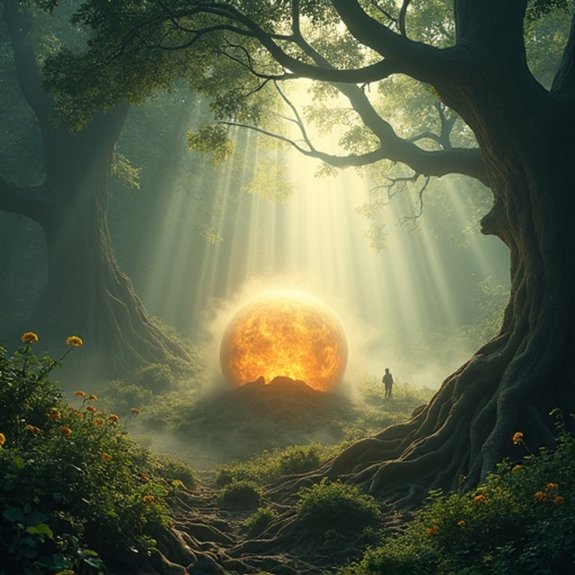
While creation myths typically exist within religious texts and oral traditions rather than eyewitness accounts, several archaeological discoveries have provided tangible evidence of humanity’s earliest birth narratives. The Enûma Eliš tablets, unearthed in Nineveh’s ruins in 1849, revealed Babylon’s cosmic birth story. Egypt’s Pyramid Texts, discovered in 1881, contained the world’s oldest religious writings detailing Ra’s self-creation.
In 1947, Bedouin shepherds found the Dead Sea Scrolls, which included Genesis creation accounts predating known manuscripts by centuries. Cave paintings in Lascaux and Chauvet show pregnant figures and birthing scenes from 30,000 years ago. Australia’s Aboriginal rock art depicts Rainbow Serpent creation stories spanning 6,000 years. These discoveries haven’t just validated oral traditions—they’ve demonstrated that birth myths formed humanity’s first attempts to explain existence itself.
Common Theories or Explanations
Most anthropologists recognize that birth myths emerged from humanity’s fundamental need to explain existence and establish social order. These narratives weren’t merely stories but served as foundational frameworks for understanding life’s mysteries. They’ve provided answers to questions about human origins, natural phenomena, and cosmic creation that early societies couldn’t otherwise explain.
Psychological theories suggest birth myths reflect universal human experiences of childbirth and maternal bonds. Jung’s collective unconscious concept proposes these stories tap into shared archetypal patterns across cultures. Meanwhile, structuralists argue that birth myths encode binary oppositions—chaos versus order, darkness versus light—that help societies organize their worldviews.
Modern scholars also examine how agricultural societies developed birth myths linking human fertility to earth’s cycles, reinforcing seasonal rituals and community cohesion.
Frequently Asked Questions
How Do Modern Indigenous Communities Preserve Their Oral Birth Myth Traditions Today?
Indigenous communities preserve birth myths through storytelling ceremonies, elder-led teachings, and cultural festivals. They’re incorporating digital recordings, community language programs, and youth mentorship while maintaining sacred protocols that protect these traditions’ spiritual integrity.
What Role Do Birth Myths Play in Contemporary Environmental Movements?
Birth myths inspire environmental movements by framing Earth as humanity’s mother, fostering protective instincts. Activists invoke creation stories to emphasize interconnectedness, sacred relationships with nature, and moral obligations to preserve what’s given life to all beings.
Are There Common Symbols Shared Across Different Cultures’ Creation Stories?
Yes, creation stories commonly share symbols of primordial waters, cosmic eggs, world trees, and serpents. They’ll often feature darkness-to-light changes, divine breath bringing life, and earth emerging from chaos through separation of elements.
How Have Feminist Scholars Reinterpreted Traditional Birth Myths?
Feminist scholars’ve reclaimed birth myths by highlighting women’s creative power, challenging patriarchal interpretations that diminished goddesses’ roles, and exposing how male-dominated societies transformed female creation deities into passive figures or erased their reproductive autonomy entirely.
What Psychological Purposes Do Birth Myths Serve in Human Development?
Birth myths help individuals understand their origins, establish identity, and process existential anxieties about creation and mortality. They’re providing psychological frameworks for meaning-making, connecting personal existence to cosmic narratives, and fostering collective belonging within cultural communities.

The Raven in Mythology Around the World

The Minotaur: Labyrinth Myths

The Underworld in Shinto Mythology
About The Author
