Haunted Trees: Spirits in the Bark
Throughout history, certain trees have earned reputations that chill even skeptics to their core. They’re not just ancient oaks or twisted elms—they’re supposedly dwelling places for restless spirits. From Celtic sacred groves to modern-day paranormal hotspots, these natural monuments attract investigators who’ve documented unexplained phenomena. But what transforms an ordinary tree into a supernatural beacon? The answer lies somewhere between ancient folklore and contemporary science.
Introduction
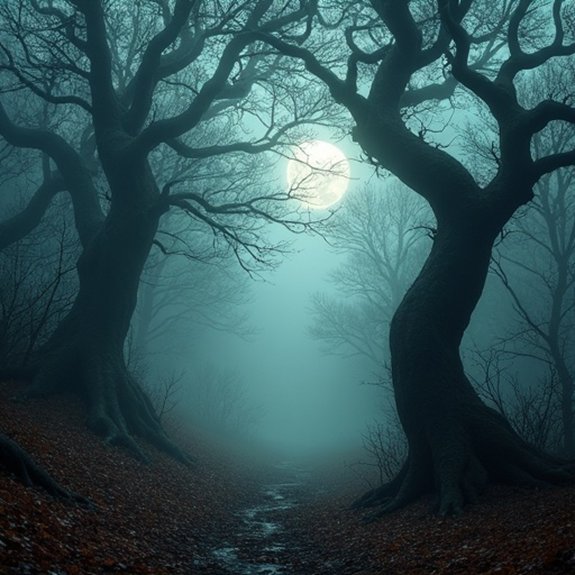
Throughout history, certain trees have gained reputations as harboring supernatural forces, becoming focal points for ghost stories, local legends, and unexplained phenomena. These haunted trees stand as silent witnesses to tragedies, executions, and mysterious deaths that’ve occurred beneath their branches. From England’s ancient oaks to Japan’s sacred cedars, cultures worldwide share tales of trees possessed by spirits or cursed by dark events.
Scientists can’t explain why some trees emit strange sounds at night or why visitors report feeling watched near specific specimens. Whether it’s the Devil’s Tree in New Jersey or the Boyington Oak in Alabama, these trees attract paranormal investigators and curious tourists alike. They’ve inspired countless photographs of alleged apparitions, recordings of unexplained voices, and reports of physical encounters that defy logical explanation.
Ancient Celtic Sacred Groves
The ancient Celts regarded certain groves of trees as gateways between the mortal world and the domain of spirits, where druids performed sacred rituals under oak, ash, and yew canopies. These nemeton sites weren’t merely forests but consecrated spaces where deities dwelt among twisted roots and whispering leaves.
Romans who encountered these groves described an overwhelming dread that seized visitors. Tacitus wrote of dark sanctuaries where human sacrifices stained bark with blood. The druids believed specific trees housed ancestral spirits who’d guide or curse those who entered uninvited.
Oak groves held particular power, serving as natural temples where druids harvested mistletoe with golden sickles during winter solstices. They’d commune with tree spirits, interpreting messages through rustling branches and falling leaves that predicted wars, harvests, and deaths.
Notable Cases or Sightings

Three documented encounters with haunted trees have captured investigators’ attention across centuries of paranormal research. England’s Clapham Wood gained notoriety when four dogs vanished near its ancient oaks in 1975, while witnesses reported disorientation and sudden illness. The Devil’s Tree in New Jersey’s Pine Barrens bears axe marks that allegedly reappear overnight, and locals claim they’ve heard screaming from its branches since the 1950s.
Japan’s Aokigahara Forest contains multiple yūrei-inhabited trees where visitors photograph mysterious figures in the bark. In 2016, paranormal researcher Kenji Tanaka recorded temperature drops of fifteen degrees near specific cedars. Australia’s Old Gum Tree in Glenelg has produced thirty-seven witness reports of a woman’s apparition since 1892, each describing identical Victorian-era clothing. These cases share common features: electromagnetic anomalies, recurring apparitions, and historical trauma at each location.
Common Theories or Explanations
Scientists and paranormal researchers have proposed several explanations for why certain trees appear haunted. Environmental factors often play a significant role—old trees naturally creak and groan as wood expands and contracts with temperature changes. Wind passing through hollow trunks can create eerie whistling sounds that mimic voices.
Some theorists believe trees’ extensive root systems act as conductors for electromagnetic energy, potentially recording and replaying past events like natural tape recorders. This “stone tape theory” suggests traumatic events leave psychic imprints on organic matter.
Skeptics attribute most experiences to pareidolia—the brain’s tendency to recognize patterns where none exist. Shadow play through branches creates faces and figures, while infrasound from swaying trees can trigger feelings of unease and hallucinations in sensitive individuals.
Frequently Asked Questions
How Can I Safely Communicate With Spirits Believed to Inhabit Haunted Trees?
One can’t scientifically verify spirit communication, but believers suggest approaching respectfully, speaking aloud with clear intentions, leaving small offerings like flowers, meditating near the tree, and remaining open to subtle signs while maintaining personal boundaries.
What Equipment Do Paranormal Investigators Use to Detect Tree-Dwelling Spirits?
Paranormal investigators typically use EMF detectors, digital voice recorders for EVP sessions, thermal cameras, and motion sensors near supposedly haunted trees. They’ll also employ dowsing rods, spirit boxes, and full-spectrum cameras to capture potential supernatural activity.
Are Certain Tree Species More Likely to Harbor Spirits Than Others?
Paranormal researchers believe ancient oaks, willows, and yews attract spirits most frequently. They’ve documented higher activity near trees with twisted trunks, hollow cores, or those growing near burial grounds and battlefields throughout history.
What Should I Do if I Encounter a Haunted Tree While Hiking?
If someone encounters a haunted tree while hiking, they shouldn’t approach or touch it. They’ll want to remain calm, avoid direct eye contact with any manifestations, and quietly continue past while showing respect for the space.
Can Haunted Trees Be Cleansed or Blessed to Remove Spiritual Entities?
Some believe haunted trees can be cleansed through rituals like smudging with sage, prayer, or blessing ceremonies. Others think spirits permanently bond with the wood. Methods vary across cultures, though there’s no scientific proof.

Ghosts in Railroad Tunnels: Echoes of Lost Lives

The Haunting of the RMS Queen Mary Update

Is the Stanley Hotel Really Haunted, or Just Hype?
About The Author
