Residual Hauntings Vs Intelligent Hauntings
When investigators enter a reportedly haunted location, they’re often confronted with a fundamental question that shapes their entire approach. The phantom footsteps echoing through an empty hallway might be nothing more than an imprint of the past, or they could signal something far more conscious. This distinction between residual and intelligent hauntings isn’t just academic speculation—it’s changed how paranormal researchers document encounters and what they believe they’re actually witnessing.
Introduction
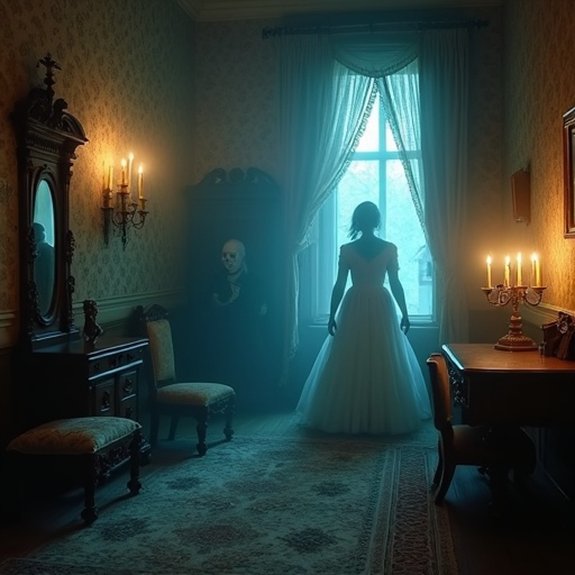
When someone experiences unexplained footsteps in an empty hallway or catches a glimpse of a shadowy figure that vanishes instantly, they’re encountering what paranormal investigators classify as either a residual or intelligent haunting. These two distinct phenomena differ fundamentally in their nature and behavior. Residual hauntings act like recordings imprinted on a location, replaying past events without any awareness of the living. They’ll repeat the same actions regardless of who’s present. Intelligent hauntings, however, involve conscious entities that can interact with their environment and respond to people. They’ll communicate through various means, move objects deliberately, and react to questions or provocations. Understanding these differences helps investigators determine what type of activity they’re dealing with and choose appropriate documentation methods for each case.
Ancient Roman Ghost Classifications
The concept of categorizing ghostly encounters isn’t new—ancient Romans developed their own sophisticated system for classifying supernatural entities nearly two thousand years ago. They distinguished between “lemures,” restless spirits who’d suffered violent deaths, and “lares,” protective ancestral ghosts watching over households. Romans believed lemures wandered aimlessly, repeating their final moments—much like today’s residual hauntings. Meanwhile, lares could communicate with the living, offer warnings, and respond to offerings, resembling modern intelligent hauntings.
The Romans also recognized “manes,” neutral spirits dwelling in the underworld, and “larvae,” malevolent entities that tormented the living. These classifications influenced how Romans approached supernatural encounters, determining whether they’d perform exorcisms, make offerings, or simply avoid certain locations. Their systematic approach laid groundwork for contemporary paranormal investigation methods.
Notable Cases or Sightings
Stone Tape Theory gained credibility when investigators documented the Brown Lady of Raynham Hall‘s repetitive appearances along the same staircase since 1835, always following an identical path without acknowledging witnesses. This residual haunting contrasts sharply with Borley Rectory‘s phenomena, where entities reportedly threw objects, wrote messages, and responded directly to living occupants’ questions between 1928 and 1939.
The USS Hornet exhibits both types. Sailors’ve witnessed a phantom officer who mechanically repeats deck inspections, never deviating from his route—classic residual behavior. Meanwhile, crew members report intelligent interactions in the ship’s sick bay, where an unseen presence answers knocks and moves medical equipment upon request. Eastern State Penitentiary‘s “Runner” demonstrates residual traits, sprinting down Cellblock 6 nightly at 10:30 PM, while Al Capone’s cell features an intelligent spirit that’s allegedly conversed with visitors about prohibition-era Chicago.
Common Theories or Explanations
Beyond documented cases, researchers’ve proposed several mechanisms to explain why hauntings manifest differently. The Stone Tape Theory suggests locations absorb emotional energy during traumatic events, then replay these impressions like recordings—explaining residual hauntings’ repetitive nature. Quantum physics offers another angle: parallel dimensions might occasionally overlap, creating ghostly encounters.
For intelligent hauntings, survival hypothesis proponents argue consciousness persists after death, allowing spirits to interact purposefully with the living. Skeptics counter with psychological explanations—pareidolia makes people perceive patterns in random stimuli, while electromagnetic fields affect brain function, triggering hallucinations.
Environmental factors also play roles. Infrasound frequencies below human hearing cause unease and visual distortions. Carbon monoxide poisoning produces hallucinations mimicking paranormal experiences. These theories don’t definitively prove or disprove hauntings but offer frameworks for understanding reported phenomena.
Frequently Asked Questions
How Can I Tell if My House Has a Residual or Intelligent Haunting?
One can test by attempting communication. If the entity responds to questions, moves objects upon request, or reacts to the living’s presence, it’s intelligent. If it repeats identical actions regardless of interaction, it’s residual.
Are Residual Hauntings Dangerous to Humans or Pets?
Residual hauntings aren’t dangerous to humans or pets. They’re like recordings playing on repeat – they can’t interact with or harm anyone. While they might startle someone who’s unprepared, they don’t pose any physical threat.
Can Intelligent Spirits Communicate Through Electronic Devices?
Paranormal investigators believe intelligent spirits can communicate through electronic devices, manipulating phones, radios, and recording equipment. They’ve documented unexplained voices on recordings, mysterious phone calls, and electromagnetic fluctuations during investigations, though scientists haven’t confirmed these claims.
Do Residual Hauntings Ever Stop Occurring on Their Own?
Yes, residual hauntings can stop on their own when environmental conditions change. They’ll fade if the energy source depletes, building renovations occur, or electromagnetic fields shift. Some investigators believe they naturally weaken over time.
Which Type of Haunting Is More Common in Modern Homes?
Most paranormal investigators believe residual hauntings occur more frequently in modern homes since they don’t require conscious spirits. These recordings of past events imprint on locations through repetitive actions or emotional situations, while intelligent hauntings remain rarer.

The Staircase Phantom: Hauntings of Old Mansions

Ghosts in Underground Tunnels & Catacombs

Do Some Ghosts Mimic the Living?
About The Author
