The Haunted Cathedrals of Europe
Europe’s ancient cathedrals harbor more than religious artifacts and stunning architecture. Phantom monks drift through Westminster Abbey’s corridors while unexplained phenomena disturb St. Vitus Cathedral’s peaceful nights. These sacred sites conceal mass burial grounds from medieval plagues beneath their foundations. Whether visitors encounter genuine supernatural activity or psychological tricks remains debatable. What’s certain is that something unsettling lurks within these stone walls, waiting to reveal itself.
Introduction

While Europe’s grand cathedrals stand as monuments to faith and architectural brilliance, they’ve also become repositories for centuries of ghost stories and supernatural encounters. These sacred spaces harbor tales of phantom monks, weeping statues, and unexplained footsteps echoing through stone corridors long after closing time.
From Westminster Abbey’s spectral processions to Prague’s St. Vitus Cathedral’s mysterious bells, visitors and clergy report encounters that defy explanation. Security cameras capture shadowy figures, tourists photograph unexpected anomalies, and maintenance workers refuse night shifts. These phenomena aren’t limited to medieval structures; even restored cathedrals experience paranormal activity.
Whether one believes in ghosts or attributes these stories to imagination, the tales persist. They’ve transformed these holy sites into dual attractions—drawing both pilgrims seeking spiritual connection and thrill-seekers hunting supernatural experiences.
Medieval Plague Burial Grounds
The mass burial sites beneath many European cathedrals contain thousands of plague victims hastily interred during the Black Death‘s devastating sweep through the continent between 1347 and 1353. Church authorities abandoned traditional burial rites when death rates overwhelmed their capacity. They’d stack bodies in crypts, seal entire chambers, and dig massive pits within cathedral grounds.
Prague’s St. Vitus Cathedral sits atop an estimated 40,000 plague dead. Barcelona’s Cathedral of the Holy Cross conceals similar numbers in forgotten ossuaries. These grounds weren’t consecrated properly—priests themselves died too quickly to perform last rites.
Archaeologists’ve discovered scratch marks inside sealed crypts where living victims were accidentally entombed. Modern renovations often unearth these sites, releasing trapped air that construction workers claim carries whispers and moans from centuries past.
Notable Cases or Sightings
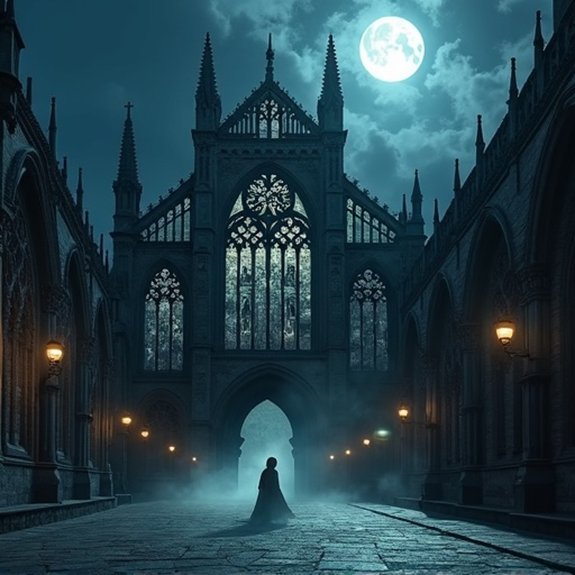
Since Winchester Cathedral’s renovation in 1905, workers’ve documented over 300 separate encounters with a gray-robed figure who materializes near the ancient crypt entrance before vanishing into the stone walls. Prague’s St. Vitus Cathedral reports similar phenomena—security cameras capture unexplained light orbs floating through the nave after midnight, while motion sensors trigger without visible cause.
Notre-Dame’s bell tower attracted international attention in 1982 when photographer Henri Dubois captured a translucent woman in medieval dress standing beside Emmanuel, the cathedral’s largest bell. The image withstood professional scrutiny for manipulation.
Cologne Cathedral’s archives contain 47 witness statements describing identical visions: a procession of hooded monks carrying candles through the ambulatory, their chanting audible despite no physical presence. These sightings peak during November, coinciding with medieval plague commemorations.
Common Theories or Explanations
Although skeptics attribute most cathedral hauntings to environmental factors, researchers’ve identified several recurring explanations for these phenomena. Stone chambers and vaulted ceilings create acoustic anomalies that produce unexplained sounds. Infrasound, below human hearing range, triggers feelings of dread and peripheral hallucinations. Temperature variations in massive stone structures cause drafts that visitors interpret as ghostly presence.
Psychological factors play significant roles. Cathedral architecture’s designed to inspire awe naturally heightens emotional states. Centuries of religious devotion create powerful expectations in visitors’ minds. The buildings’ violent histories—executions, battles, burials—fuel imagination.
Some paranormal investigators propose residual energy theory. They believe limestone and quartz in cathedral walls store electromagnetic impressions of past events. Others suggest dimensional overlap occurs at these ancient sacred sites, allowing glimpses into parallel realities.
Frequently Asked Questions
Can Visitors Attend Regular Religious Services at Reportedly Haunted Cathedrals?
Yes, visitors can attend regular religious services at reportedly haunted cathedrals. These historic buildings remain active places of worship where clergy conduct daily masses, prayers, and ceremonies. They’re open to all who wish to participate.
What Safety Precautions Should Tourists Take When Exploring These Cathedrals at Night?
Tourists shouldn’t explore cathedrals at night without permission, as they’re typically closed. If attending authorized evening events, they’ll need flashlights, should stay with groups, watch for uneven floors, and respect barriers around fragile areas.
Are Ghost Tours Available at These Cathedrals and How Much Do They Cost?
Many European cathedrals offer ghost tours, particularly York Minster, Edinburgh’s St. Giles’, and Prague’s St. Vitus. They’ll typically charge between €15-35 per person. Westminster Abbey’s evening tours cost around £30, while smaller venues charge less.
Which Months or Seasons Have the Most Reported Paranormal Activity?
October through February typically see the most reported paranormal activity at Europe’s haunted cathedrals. Witnesses claim they’ve experienced more ghostly encounters during autumn and winter months, particularly around Halloween, All Saints’ Day, and Christmas seasons.
Do Cathedral Staff Members Believe in the Hauntings They Hear About?
Cathedral staff members’ beliefs vary widely – some embrace the ghost stories as part of their building’s heritage, while others dismiss them as tourist folklore. Most maintain professional neutrality, though many privately admit experiencing unexplained phenomena.
Do Ghostly Children Still Haunt the Bridges of Texas?

Haunted Mountain Passes

The Apparition in the Mirror: Ghostly Reflections
About The Author
